

|
Catalog printing and mailing:
knowledgeable by dint of
long-&-broad success,
on-time and right, from the Midwest
|
|
(800) 562-0888
|
MaryCampanella@printEasy.net
|

|
|
|
|

Print your catalogs in the Midwest,
get it done right,
and live a quiet life

All printing is manufacturing.
Catalog printing is
custom
manufacturing.
Catalog Printing is not the same as
printing the New York Times,
everything
(for the press room)
the same every day.
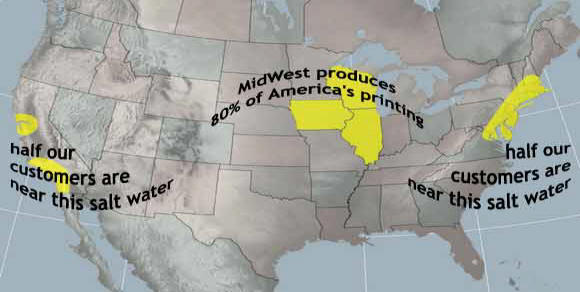
Midwest printing provides regional specialization,
a critical mass of skilled craftsman
and the planet's
full range of optimized printing-&-binding--mailing
equipment).
This critical mass is the
natural-&-happy result
of the fact that 80% -- eighty percent --
of America's printing, except newspapers, is produced
in three Midwestern states, Illinois, Iowa, and Wisconsin.
Happily,
almost everything in the Midwest costs less
than on the two coasts,
certainly including printing.
Not so fast, I'm still skeptical
Show me more about how I will

OK-fine, got it:
let's discuss my requirements.

|
|
|
|
|
|